
Loading your progress…
Accessioning and aliquoting: preserve the specimen’s story.
Learn the reasoning that keeps identity, specimen integrity, and documentation connected from receipt through an approved aliquot.
Why traceability comes before a technical step
Accessioning and aliquoting are not clerical extras. They preserve the link among the patient, request, specimen, container, test, and every action that follows. A correctly prepared sample with an unclear identity or history may be unusable. Start by verifying what is present, what the test requires, and what the laboratory’s process authorizes you to do.
A reliable handoff sequence
- Reconcile the request and specimen. Check the information, specimen type, container, collection details, and special handling against the current laboratory process. A mismatch is a reason to pause and notify; it is not an invitation to make the paperwork match from memory.
- Assess before manipulating. Look for a concern defined by the laboratory, such as damage, leakage, unsuitable container, missing information, or an issue with volume or handling. Document what is known so the laboratory can apply its acceptance criteria.
- Aliquot only under the approved procedure. A secondary specimen must remain traceable to its source. The approved process defines when an aliquot is needed, which container to use, what identifiers and labels it needs, and how to record the action.
- Protect integrity and containment. Use the required transport or storage route after preparation. Do not make a general-purpose assumption about temperature, time, light, or whether a specimen may be used for an add-on.
- Escalate uncertainty early. If the test requirement, source specimen, or next action is unclear, preserve the material and ask the laboratory. A short pause can avoid a lost specimen and an unnecessary recollection.
At fictional Cedar Lane Clinic, an order is added after the original specimen has been processed. The SOP directs staff to confirm add-on acceptability in the laboratory information system before making any aliquot. The safe response is to verify the test-specific requirement and use the approved labeling path—not to pour into an unlabeled spare tube “just in case.”
Retrieval practice
Prompt: What makes an aliquot trustworthy?
Answer: It stays demonstrably connected to the original patient, specimen, request, and preparation history through the laboratory’s approved container, label, and documentation process.
Apply the idea
Two cases. Explain the difference.
Read the supplied facts, decide what matters, then compare your reasoning. The fictional SOP steps belong to each case; the named laboratory examples retain their stated scope.
Case 1
A separated liquid cannot substitute for the cells
The requisition names Labcorp 005009, Complete Blood Count (CBC) With Differential, Reflex to Peripheral Smear Review. The directory requires intact EDTA whole blood. A received tube has already had its plasma removed. The receiving SOP requires documenting this condition and consulting the laboratory acceptance route.
Decide first: Does the remaining tube label make this an acceptable CBC submission?
Compare your reasoning
The decision
Keep the original identity and observed processing history together and refer the discrepancy for the laboratory’s acceptance decision. Do not present the altered tube as intact whole blood.
Why it follows
The requested measurement examines blood cells and their relationships in the specified specimen. Removing part of the specimen changes the submitted state. Correct patient identity alone cannot restore the required specimen composition.
Why the alternatives fail
- Send the removed plasma as the CBC sample. A cell-count request is not fulfilled by its separated liquid fraction.
- Pour the plasma back and call the tube intact. Recombining material does not establish the original validated specimen state or repair the handling history.
- Relabel the tube as never processed. That would conceal a condition the laboratory needs to assess.
Compare: For this named CBC, intact whole blood is the requirement. The next case calls for a specific separated liquid: “processing” is not one identical operation for every order.
Sources checked 2026-10-13
Named assay: EDTA whole blood; plasma-removed/transferred-blood rejection. Do not transfer the requirement to all cell-count systems.
Case 2
The aliquot needs both the right matrix and its history
A different requisition names Labcorp 004259, TSH, for a red-top serum submission. Its directory calls for separating the liquid into a plastic transport tube. In Cedar Lane’s fictional workflow, the validated separation has been completed and the aliquot must retain the approved link to the original patient, order, collection and processing record. A second prepared tube on the rack has no such link.
Decide first: Which aliquot can enter the approved handoff, and what makes the other one unresolved?
Compare your reasoning
The decision
Use the correctly identified and traceable aliquot under the supplied workflow. Quarantine the unlinked tube through the local discrepancy process; do not choose its identity from rack position.
Why it follows
This test uses the accepted liquid matrix rather than an intact cell-count specimen. Separation can produce the requested material, but it also creates another container where identity can be lost. The preparation and identity links are two separate requirements.
Why the alternatives fail
- Use EDTA plasma because both samples are called plasma. The named TSH method excludes EDTA plasma; the additive and accepted matrix still matter.
- Infer identity from the adjacent rack tube. Physical proximity does not establish a verified relationship to the patient and order.
- Treat every aliquot as inherently unacceptable. The supplied method specifically permits the correctly prepared, traceable liquid submission.
Compare: The CBC case protects an intact cell specimen. This case protects a method-approved separated fraction and the documentation connecting that new container to its source.
Sources checked 2026-10-13
Named assay: serum preferred or lithium-heparin plasma; specified red-top/plasma separation submission. No centrifuge settings or universal supplement stopping interval is taught.
Source boundary: ASCP BOC PBT Examination Content Guideline includes specimen acceptability, accessioning/labeling, centrifugation, aliquoting, transport, and storage. The exact procedure is laboratory-, test-, and manufacturer-specific.
Inspect the named laboratory examples for differences between an intact blood tube and a prepared liquid aliquot. Match the submitted matrix and its identity to the actual order, rather than treating the original tube and final aliquot as the same state.
Observe, then explain
Look closer.
Trace identity from the primary container into any secondary tube or prepared slide.
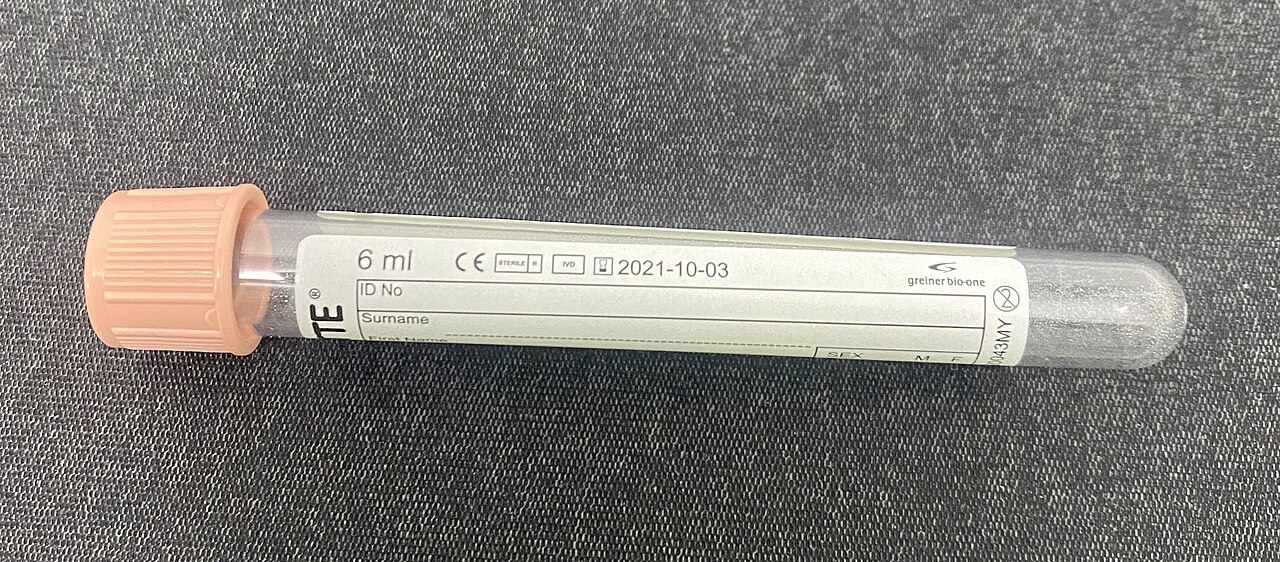
Photograph 1 of 3
Identity belongs to the specimen
These empty identity fields contain no patient information. A real collected specimen needs the approved patient-specific label and verification workflow.
Photo: Whispyhistory. Source · CC BY-SA 4.0.
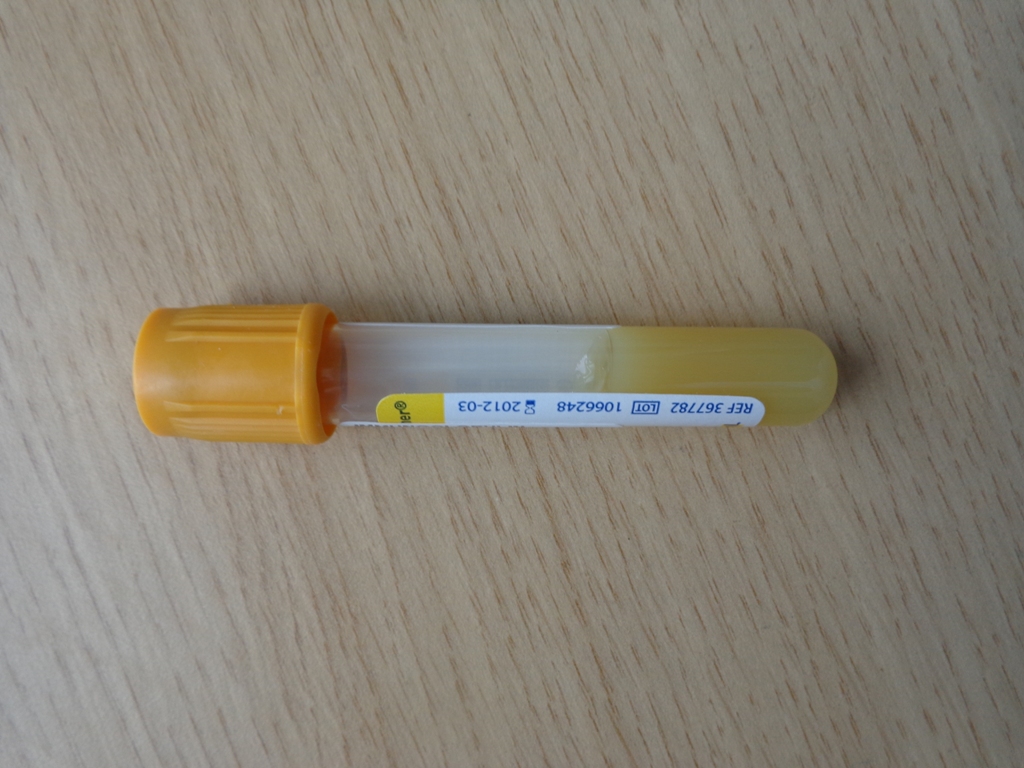
Photograph 2 of 3
A tube is more than its cap
A container photograph supports recognition. Confirm its labeled additive and current instructions before deciding what specimen or test it can support.
Photo: AfroBrazilian. Source · CC BY-SA 3.0.
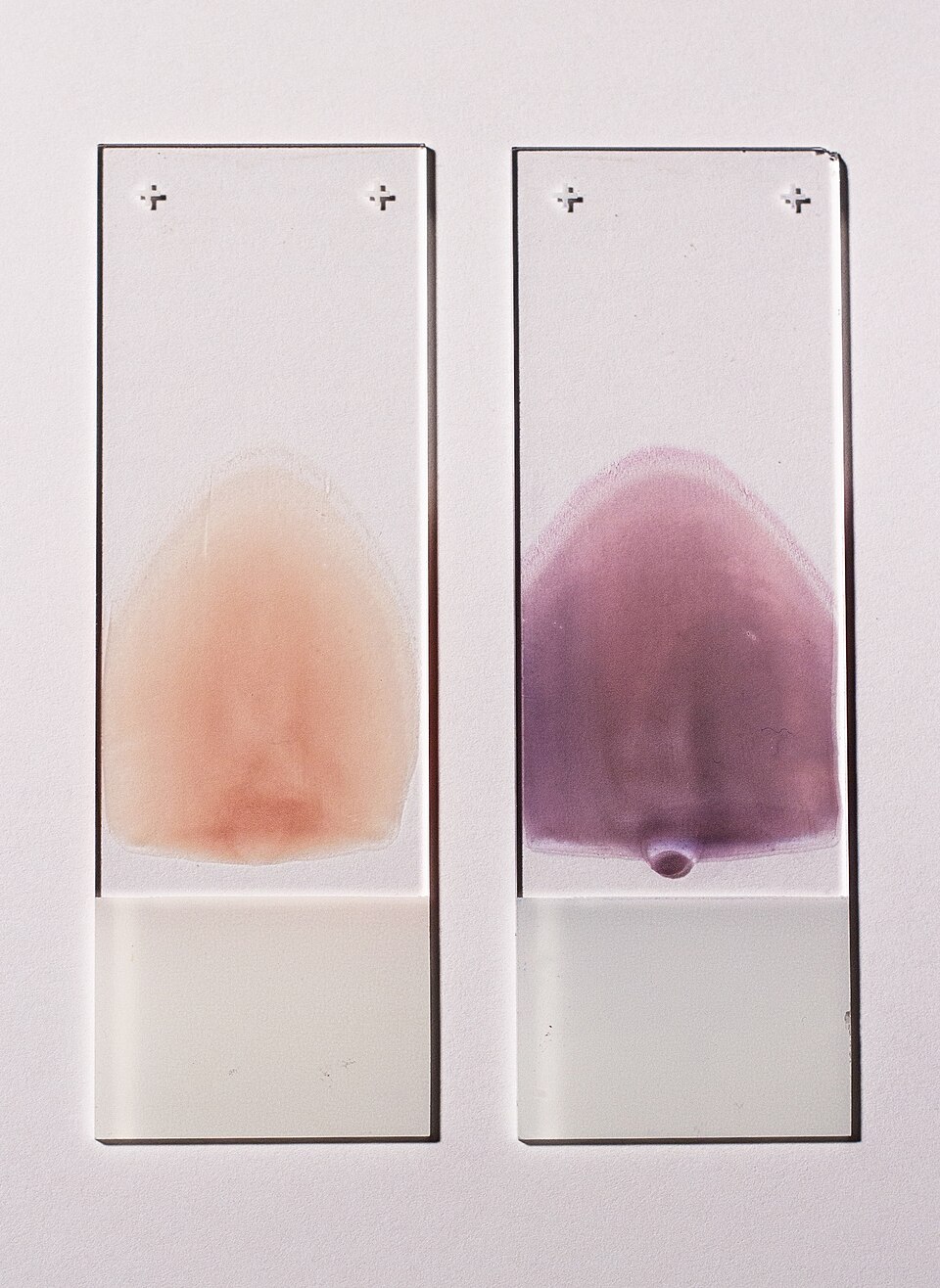
Photograph 3 of 3
Preparation changes what the laboratory can see
Unstained and Wright-Giemsa-stained peripheral blood smears. Preparation supports a later examination; this image alone cannot prove identity, preparation quality, or diagnostic findings.
Photo: Coinmac. Source · CC BY-SA 3.0.
Which information must remain linked when a laboratory creates a secondary preparation?
Keep the approved patient and specimen identity, accession relationship, specimen type, and required processing history linked through the local traceability procedure. A copied cap color cannot preserve that relationship.
Real photographs, source and depiction checked 2026-10-13. Images display in full without cropping. A photo can support observation; use the current procedure and device instructions for clinical work.
Deliberate practice
Learn it, then use it.
These are original study prompts, not recalled certification questions. Answer before opening the rationale.
By the end, you can
- Connect accessioning and aliquoting to patient identity, request, specimen, and handling traceability.
- Recognize an unclear add-on, label, or specimen condition as a reason to pause and verify.
- Use the approved laboratory process rather than making an unlabeled or undocumented secondary specimen.
Decision point
An add-on order arrives after processing, but you cannot confirm that the original specimen is acceptable for the new test. What should you do?
Reveal the best next step and why
Best next step: Preserve the specimen and verify the test-specific add-on requirement with the laboratory before preparing an aliquot.
Why: An aliquot must remain traceable and suitable for the requested test. The laboratory's validated method and current directory define whether the original specimen can be used.
Retrieval practice
1.What must an approved aliquot remain connected to?
The original patient, specimen, request, and preparation history through the approved label and documentation process.
2.What should you do with an unclear accessioning mismatch?
Preserve the facts and contact the laboratory or supervisor rather than correcting it from memory.
Finished reading?
Next: Centrifugation and timing