
Loading your progress…
Point-of-care testing: quality before a result.
A practical quality loop for point-of-care testing: authorization, identification, readiness, control response, documentation, and escalation.
Why a fast answer still needs a quality system
Point-of-care testing can bring a result close to the patient, but it does not remove the need for an authorized operator, a correctly identified patient, a device-specific procedure, quality checks, documentation, and escalation. The test kit or instrument instructions and the organization’s POCT program decide the permitted workflow—not a general rule remembered from another device.
Use a pre-result safety check
- Confirm authorization and the current procedure. Operate only within your training, competency status, and the organization’s POCT process. Verify the exact device, test, specimen type, and current manufacturer instruction before beginning.
- Protect patient and sample identification. Match the patient and order through the approved workflow. A rapid test result attached to the wrong patient is not made safer by its quick turnaround.
- Check readiness before patient testing. The local program and manufacturer instructions define storage, expiration, maintenance, calibration or verification, quality-control material, and acceptable control results. Do not invent a schedule or borrow one from another device.
- Respond to an out-of-control condition. A failed control or instrument alert is a stop signal. Do not report patient results until the authorized troubleshooting and quality process resolves the condition or directs an alternative path.
- Document and communicate through the system. Record required quality activity, patient testing, corrective action, and escalation through the approved record. If the result needs clinical interpretation or urgent action, use the setting’s notification process.
At fictional Cedar Lane Clinic, a glucose device displays a control failure immediately before a patient test. The SOP says to stop patient testing, check the current device procedure, document the event, and notify the designated POCT contact if the issue is not resolved. Running the patient sample “to save time” is not an acceptable workaround.
Retrieval practice
Prompt: What is the safest conclusion from a failed control?
Answer: The testing system may not be ready to produce a reliable patient result. Stop, follow the authorized troubleshooting and documentation process, and escalate rather than guessing that a patient result is still usable.
Apply the idea
Two cases. Explain the difference.
Read the supplied facts, decide what matters, then compare your reasoning. The fictional SOP steps belong to each case; the named laboratory examples retain their stated scope.
Case 1
A believable patient number does not resolve failed control
Fictional Maple Clinic’s selected waived system requires the external control checks stated in its current instructions. The clinic’s SOP says that an out-of-range required control blocks patient testing and result release until the authorized investigation resolves it. The control is outside its stated acceptable range, but a patient number displayed on the instrument looks plausible.
Decide first: Can plausibility replace the required acceptable control?
Compare your reasoning
The decision
Follow the supplied stop-and-investigate path. Retain the control, lot, device and observed-result facts for the authorized review; do not release the patient number as a valid result.
Why it follows
A required control checks part of the testing process against a known expectation. A patient number has no known true value available merely from its appearance. A plausible display cannot demonstrate that the failed control requirement has been met.
Why the alternatives fail
- Release the number because it falls near an expected range. Expected patient ranges do not prove this measurement system is performing acceptably.
- Edit the control log to match its expected value. That would replace the observed failure with false evidence.
- Repeat until a desired answer appears and erase the first run. The supplied SOP requires a documented investigation; selective retention conceals the unresolved failure.
Compare: An internal procedural indicator and an external control can check different parts of a system. Use this device’s actual requirements; do not assume that one visible indicator replaces every required control.
Sources checked 2026-10-13
Waived tests can produce serious errors; follow manufacturer instructions. The control requirements and action steps in the case belong only to the supplied fictional SOP.
Case 2
A successful control does not approve the wrong specimen
On a later day, Maple Clinic’s required controls are acceptable. The selected system’s supplied instructions accept the specified capillary whole-blood sample and exclude plasma. A labeled plasma aliquot from another order is offered as a convenient substitute. The fictional SOP requires a matching specimen and complete identity check before testing.
Decide first: What remains to be checked after the controls pass?
Compare your reasoning
The decision
Match the actual specimen and patient identity to the selected system’s requirements. Decline the proposed substitution through the supplied workflow; acceptable controls do not authorize a different matrix.
Why it follows
A control result answers a quality check under specified conditions. It does not change which patient specimen the method accepts. Matrix, preparation, device compatibility and identity still need to fit the requested measurement.
Why the alternatives fail
- Use the plasma because the control passed. The accepted control has not validated a matrix the supplied instructions exclude.
- Assume all waived devices accept the same material. Waived classification does not make different manufacturer methods interchangeable.
- Enter a central-laboratory result as if this bedside device measured it. That would falsely describe which method produced the result and break traceability.
Compare: The first case has an unresolved testing-quality condition. This case has acceptable controls but an incompatible patient specimen. Both can block a valid result for different reasons.
Sources checked 2026-10-13
Waived tests can produce serious errors; follow manufacturer instructions. The control requirements and action steps in the case belong only to the supplied fictional SOP.
Source boundary: CMS CLIA overview describes federal quality standards for human laboratory testing, and the ASCP PBT guideline includes POCT performance, troubleshooting, maintenance, and quality control. Follow the device IFU and local POCT program.
Observe, then explain
Look closer.
Connect a meter, kit label, and result cassette to separate readiness checks before testing and reporting.
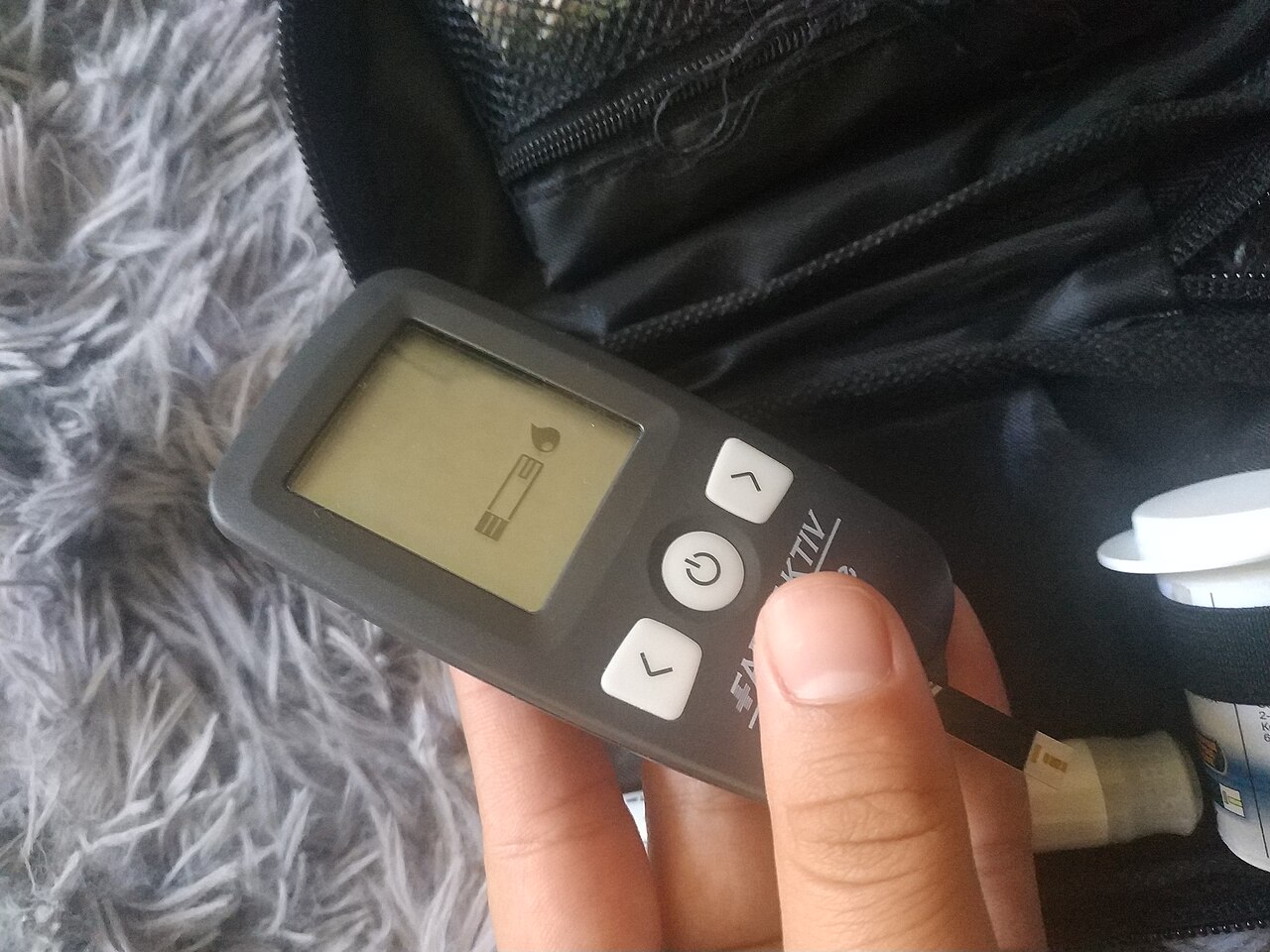
Photograph 1 of 3
A glucose meter and its supplies
A real glucose-meter photograph. Recognize the meter, strip supplies, and display; its appearance does not establish operator authorization, control results, or approval for your testing site.
Photo: Anelya Topoleva. Source · CC BY-SA 4.0.
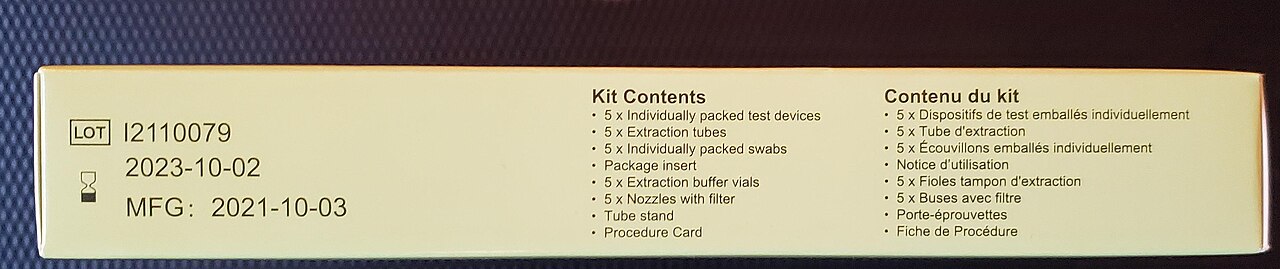
Photograph 2 of 3
Lot, expiry, and kit contents
This photographed kit label is expired and historical. Identify lot, expiry, and component information, then use the current approved kit instructions. A package photo does not establish U.S. waived status.
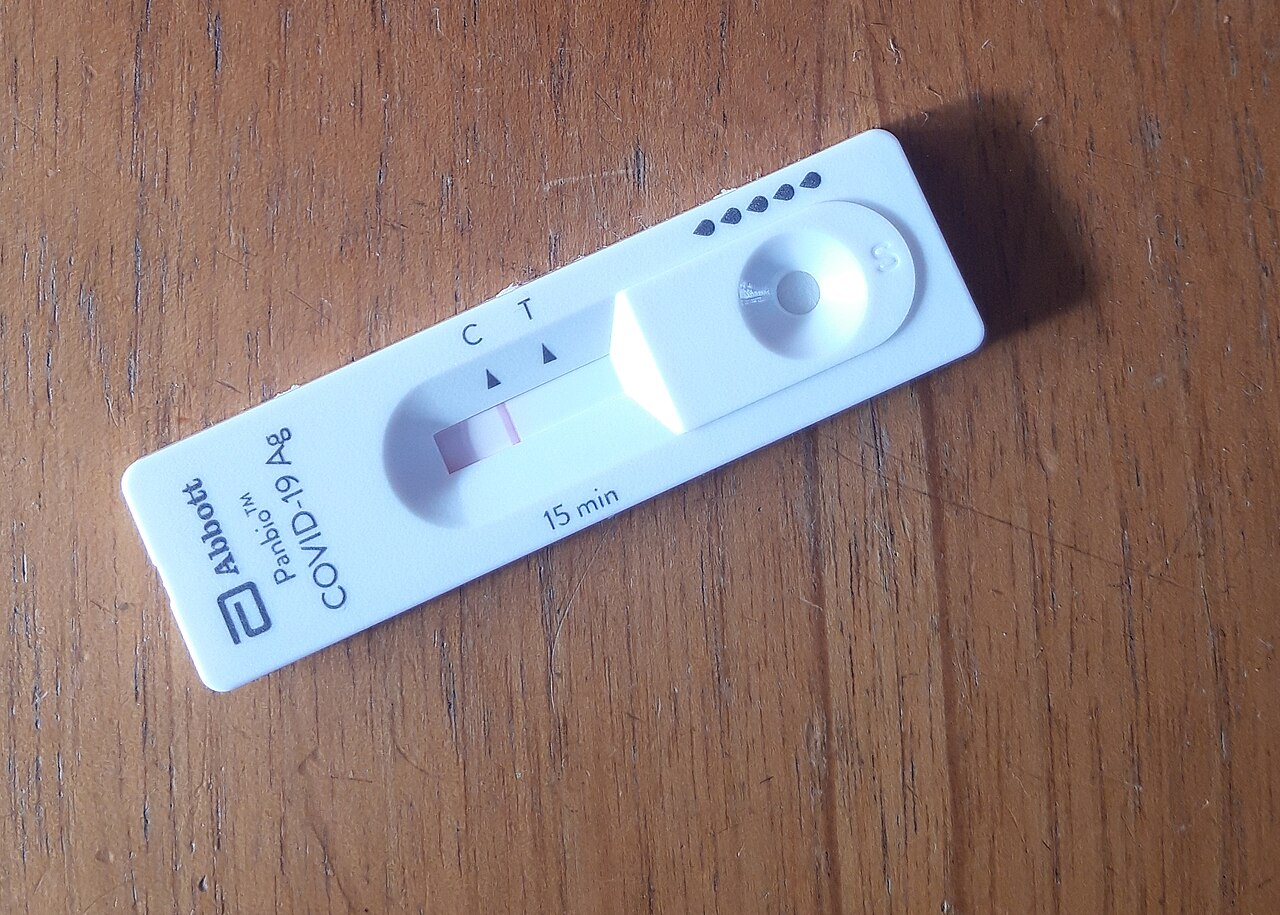
Photograph 3 of 3
A lateral-flow test cassette
The cassette has a sample well and control/test markings. A still image cannot establish collection quality, valid reading time, or a patient result. Use the applicable current instructions and reporting process.
Do the meter display or the cassette markings establish acceptable quality control?
No. The authorized operator needs the current device instructions, required control evidence, correct specimen, reading time, and reporting process. A photographed device or package cannot establish that the system is ready for patient testing.
Real photographs, source and depiction checked 2026-10-13. Images display in full without cropping. A photo can support observation; use the current procedure and device instructions for clinical work.
Deliberate practice
Learn it, then use it.
These are original study prompts, not recalled certification questions. Answer before opening the rationale.
By the end, you can
- Explain why authorization, identification, device readiness, quality activity, and documentation precede a POCT result.
- Treat a failed control or instrument alert as a stop-and-escalate event.
- Separate device-specific instructions from general quality reasoning.
Decision point
A point-of-care control fails just before patient testing. What is the safest next action?
Reveal the best next step and why
Best next step: Stop patient testing and follow the current device and local POCT troubleshooting, documentation, and escalation process.
Why: A failed control can mean the testing system is not ready to produce a reliable patient result. It is not a reason to run a patient sample quickly and explain later.
Retrieval practice
1.What source controls a POCT device's control and maintenance process?
The current device instructions and the organization's POCT program.
2.Who should decide how to manage an unresolved device issue?
The authorized local POCT or laboratory escalation pathway.
Finished reading?
Next: Practice safety and laboratory quality