
Loading your progress…
Order of draw: verify the sequence.
Understand additive carryover, then use the current sequence for the collection method, tube system, and laboratory procedure in front of you.
Why this matters
Order of draw is a pre-analytical safeguard: it helps limit the chance that material from one collection affects a later specimen. The correct sequence is not a color-only fact. It depends on the collection method, the tube or device instructions, the requested tests, and the laboratory's current validated procedure.
Key takeaways
- Start with the collection method. Venous and capillary collections can have different sequences. Confirm which method the procedure covers before applying any memory aid.
- Read the additive, not only the cap color. Cap colors and tube formulations can vary. The test directory, tube label, and manufacturer instructions identify the required specimen.
- Use the current blood-culture procedure. Culture bottle order, fill, and collection workflow depend on the collection system and method. Follow the current laboratory and manufacturer instructions.
- Fill and mix only as instructed. Required fill volume and handling are part of the specimen requirement. If a tube is not filled or handled as required, verify the next step with the laboratory.
- Do not make a result fit a mnemonic. If an order, tube, or instruction conflicts with what you memorized, stop and use the validated written procedure.
A mnemonic can help you study categories, but it is not a clinical order. In practice, the current laboratory collection manual and the relevant manufacturer's instructions control the sequence.
Adult blood cultures: keep each set distinct
The CDC's March 2026 adult collection model explains why culture quality is more than remembering which bottle comes first. For a suspected bloodstream infection, the local SOP should identify the culture system, collection sites, bottle preparation, intended volume, and route to the lab. A second adult set should use a separate venipuncture site. Record the actual volume in each bottle, the exact time and date, site, method, and collector. Those facts help the laboratory interpret a possible contaminant; a cap-color mnemonic cannot recover missing collection details.
In a fictional case, the second set fills less than planned. Recording the planned volume would conceal the problem. Document the measured volume and consult the culture SOP about next steps. CDC's adult collection targets do not set a pediatric volume, and the institution's current system controls the exact containers and sequence.
Adult source: CDC, Collect Adult Blood Culture Sets (March 2026).
Apply the rule
Your study mnemonic conflicts with the instructions supplied for the current collection system. What controls? The current validated laboratory procedure and the relevant manufacturer instructions. Ask the laboratory before collecting if the sequence is still unclear.
Take the full free 10-question quiz →
Current-reference note: CLSI PRE02, 8th edition (2025) supersedes GP41-Ed7. The paid standard is not reproduced here. For adult blood-culture collection, use current CDC guidance together with collection-system and laboratory instructions. PhlebotomySkills.com is exam-preparation content, not a clinical procedure manual.
Apply the idea
Two cases. Explain the difference.
Read the supplied facts, decide what matters, then compare your reasoning. The fictional SOP steps belong to each case; the named laboratory examples retain their stated scope.
Case 1
The second adult set needs its own collection history
In fictional Harbor Hospital's adult blood-culture workflow, the first set has been collected from the left antecubital site. The supplied SOP follows the CDC adult model and calls for a separate venipuncture site for the second set. A coworker suggests using the same puncture again because it would be faster.
Decide first: What makes the proposed shortcut a problem beyond bottle order?
Compare your reasoning
The decision
Use the second-site route specified by the SOP or seek the authorized clinical decision if that is not possible. Keep the two sets' site and time records distinct.
Why it follows
Two sets contribute to evaluating possible contamination. The CDC adult model calls for a separate venipuncture site for the second set, with actual site, collection method, and time documented. Changing the site history to save time removes information used to interpret the sets.
Why the alternatives fail
- Use the same puncture and enter a different site in the record. That invents a collection history the laboratory may rely on.
- Treat the two bottles of the first set as two separately collected sets. Bottle count and independent collection sets are different facts.
- Apply the adult model unchanged to a child. The cited CDC page is adult-specific; pediatric collection needs its own instructions.
Compare: This case asks whether two sets are independently collected and traceable. The next asks whether the recorded volume represents what actually entered each bottle.
Sources checked 2026-10-14
Adult model, steps 9–13; second-set separate site and collection documentation. The hospital SOP is fictional.
Case 2
Record the volume obtained, not the volume planned
The same adult culture workflow names a target volume in its selected bottle system. The second bottle fills below that target. The collector can see the measured amount, but a coworker proposes entering the target amount so the record looks complete. The SOP assigns acceptance and any follow-up decision to the laboratory.
Decide first: Which value should enter the record, and who decides what follows?
Compare your reasoning
The decision
Document the actual measured volume and the collection facts, then use the laboratory's escalation route for an acceptance or follow-up decision. Do not alter the record to match the target.
Why it follows
CDC identifies collected blood volume as important to adult culture performance and calls for the volume in each bottle to be measured and documented. A planned target is a goal, whereas the actual volume is a specimen fact needed to interpret the collection.
Why the alternatives fail
- Record the target because it was the intended fill. That conceals the observed difference between plan and specimen.
- Infer the missing volume from the other bottle. The other bottle does not measure this bottle's contents.
- Automatically discard the whole set. The case assigns the acceptance decision to the laboratory and supplies no rule making every short fill a discard.
Compare: A separately collected site does not prove an adequate volume, and an adequate volume does not prove an independent site. Record both dimensions honestly.
Sources checked 2026-10-14
Adult model, volume importance and steps 6–12. No pediatric target or universal bottle acceptance threshold is taught.
Technical application
Learn the sequence and the reason it exists
- Explain additive carryover without treating every abnormal result as contamination.
- Read a fully specified venous sequence.
- Distinguish bottle, tube and capillary sequences.
A sequence controls an avoidable source of error
Order of draw is a preanalytical control: material from one container should not alter the sample intended for another measurement. The additive that is helpful in its intended specimen can be a contaminant in another. Learning the mechanism is more durable than remembering colors alone, because product colors can vary while the specimen requirements remain meaningful.
Do not overinterpret the mechanism. A result inconsistent with expectation has several possible explanations, including a real patient change. A collection concern should prompt a documented laboratory investigation, not an unsupported diagnosis of contamination. The patient's result, the collection history and the analytical method all matter.
Practice a complete stated sequence
For the following fictional clinic exercise, the supplied venous procedure states: culture containers, citrate coagulation product, serum product, heparin product, EDTA product, then the specified glycolysis-inhibitor product. This supplied sequence is enough to solve the exercise. Write the requested containers in that order before translating them into the labeled products at the bench.
Now remove containers that are not ordered without reversing the order of those that remain. If the fictional order requires citrate, serum and EDTA, the sequence is citrate, serum, EDTA. Do not add an unrequested collection just to complete a mnemonic. Whether a special discard or collection-system preparation step is needed is a separate instruction, not another universal color in the sequence.
Three different sequences can be involved
The order among venous tubes, the order between culture bottles for a particular collection system, and the order among capillary containers answer different questions. A winged set, syringe and other system may not use identical bottle-handling instructions. A microcollection procedure also does not become venous merely because its container has a familiar additive.
When comparing instructions, identify route, device, container and source date. Two diagrams may conflict because they describe different methods, or one may be outdated. A useful answer names that difference. 'The blue one is always second' cannot explain a collection with no cultures or a system with a separate preparation requirement.
| Supplied fictional order | Requested containers | Result |
|---|---|---|
| Culture → citrate → serum → heparin → EDTA → inhibitor | Citrate, EDTA, serum | Citrate → serum → EDTA |
| Same supplied order | Serum, heparin | Serum → heparin |
| Capillary instruction not supplied | Several capillary containers | Obtain the capillary method; do not import the venous sequence |
Work the case before revealing the explanation
Which fact controls the decision?
Under the supplied fictional venous sequence, an order requests citrate, serum and EDTA. A trainee proposes EDTA first because that tube is closest.
Read the decision and its mechanism
Decision: Use citrate, then serum, then EDTA under the supplied procedure.
Why: Convenience does not change the relationship among the requested containers. All facts necessary to order this exercise are already supplied.
Now change the facts
The order is now capillary microcollection, and the sheet explicitly identifies a different method-specific sequence.
Compare your changed decision
Apply that capillary sheet. The earlier venous exercise does not overrule it.
Check your reasoning
Answer aloud or in writing before opening each explanation. Return to these questions in a later study session.
What makes a sequence answer defensible?
It matches the specified route, device, containers and current procedure.
Does a suspicious result prove additive carryover?
No. Preserve and investigate the collection facts without deciding the patient's diagnosis.
Keep these distinctions
- Know the stated order and why carryover matters.
- Separate tube order from bottle order and special preparation steps.
- Do not substitute a venous mnemonic for a capillary procedure.
Observe, then explain
Look closer.
Compare the collection system with individual containers. Identify the method before deciding the sequence.
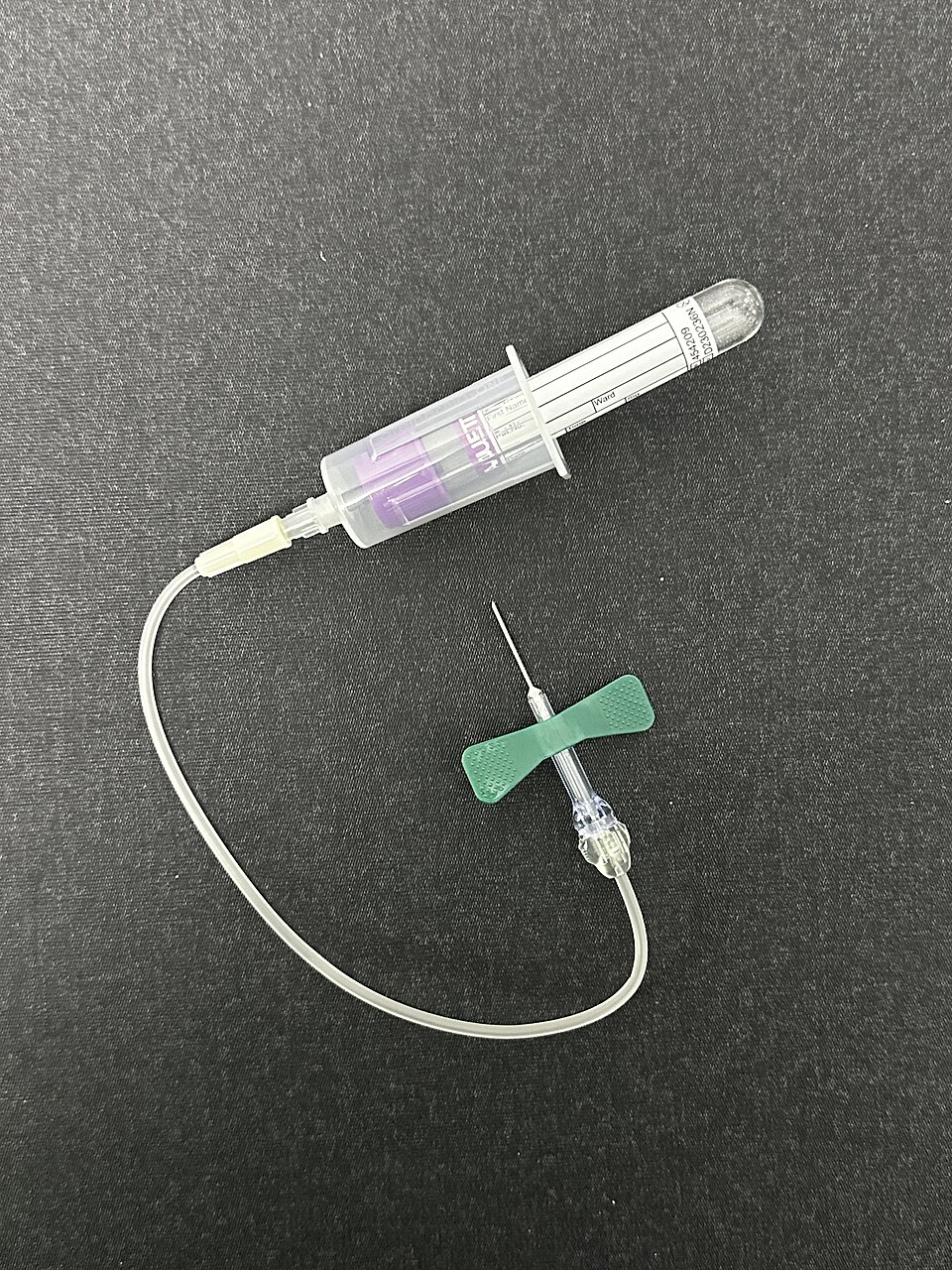
Photograph 1 of 3
Winged set, tubing, holder, and tube
This equipment photograph shows the tubing between needle and holder. It depicts an exposed sharp; use the approved safety device and supervised handling procedure.
Photo: Whispyhistory at English Wikipedia. Source · CC BY 3.0 US.
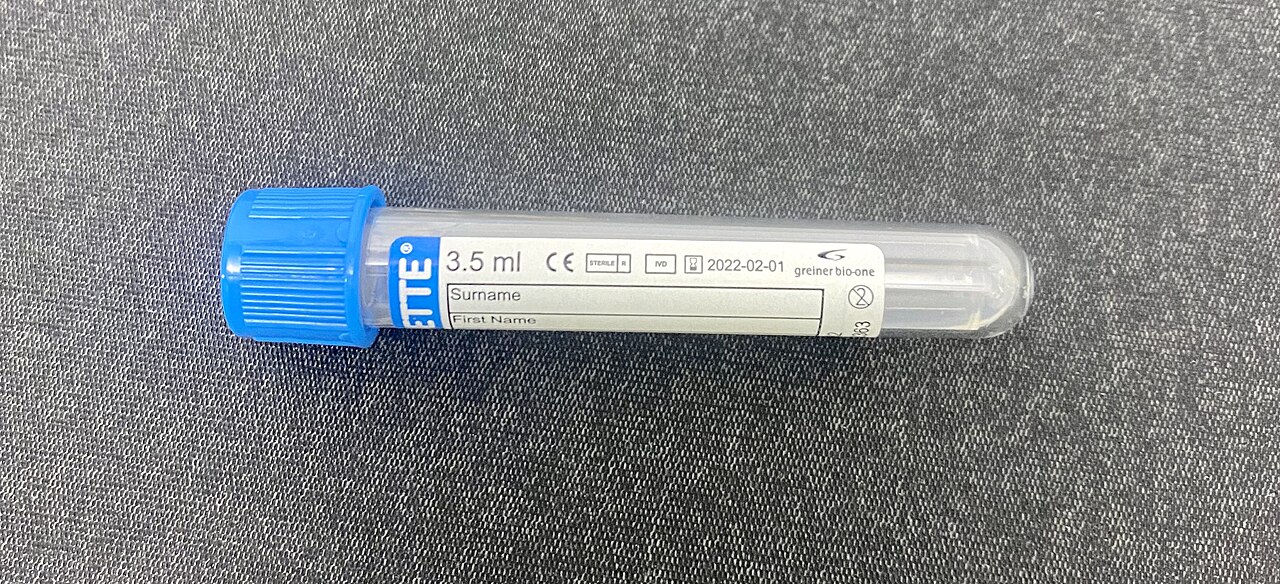
Photograph 2 of 3
Read the tube label
The label has blank identity fields and printed device information. The cap alone does not tell you the complete test requirement. The pictured expiry is historical.
Photo: Whispyhistory. Source · CC BY-SA 4.0.
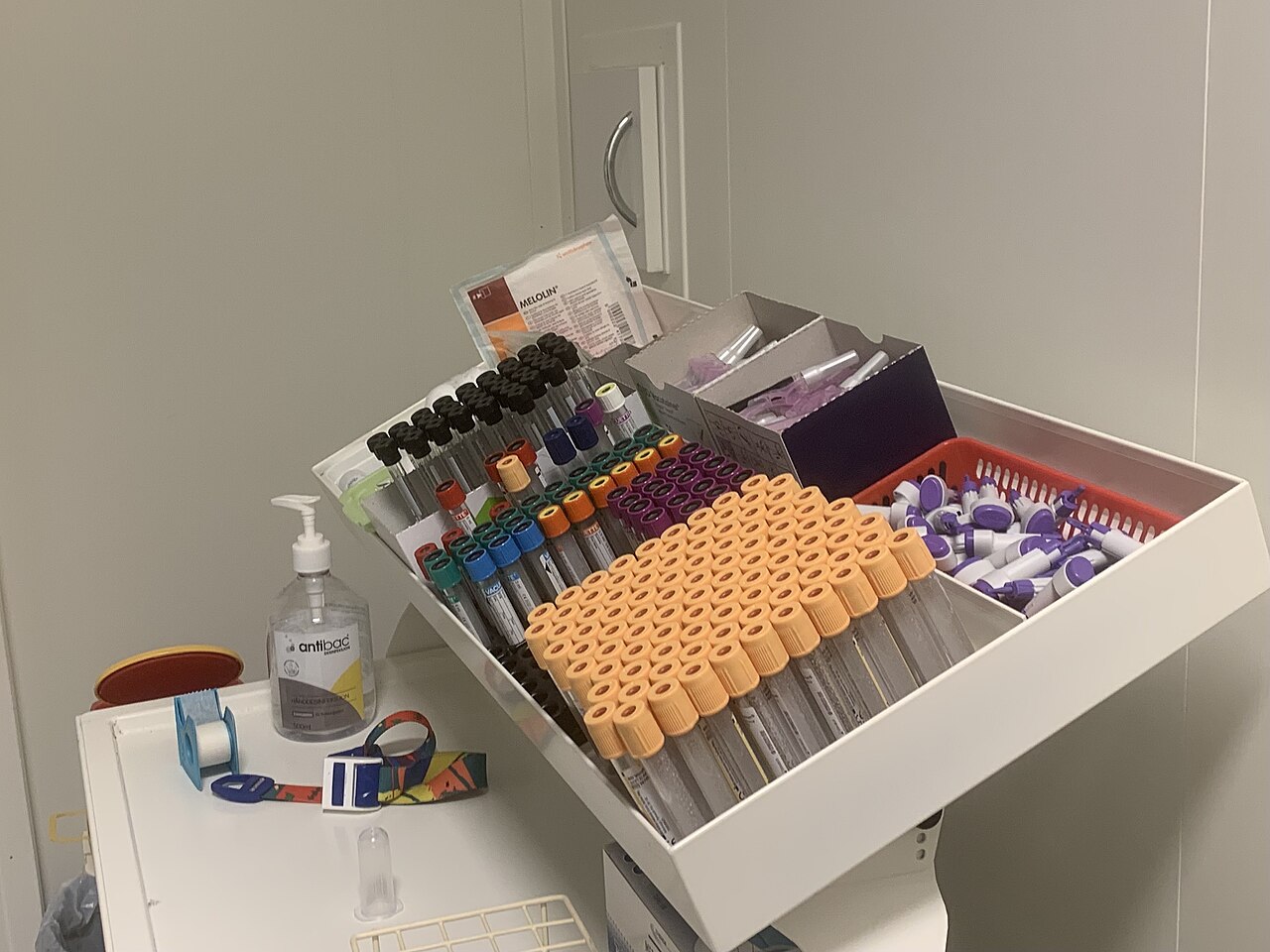
Photograph 3 of 3
Supplies before collection
A real clinic supply area in Norway. Recognize the equipment, then verify the local container, storage, cleaning, and collection requirements.
Photo: Marius Vassnes. Source · CC BY-SA 4.0.
Can you determine the required sequence from the rack arrangement?
No. A supply rack is storage, not an order of draw. Use the collection method, current laboratory sequence, test requirements, and device instructions.
Real photographs, source and depiction checked 2026-10-13. Images display in full without cropping. A photo can support observation; use the current procedure and device instructions for clinical work.
Deliberate practice
Learn it, then use it.
These are original study prompts, not recalled certification questions. Answer before opening the rationale.
By the end, you can
- Explain why additive carryover can matter to a result.
- Use the order specified by the collection method, tube manufacturer, and local laboratory policy.
- Recognize an underfilled or mismatched additive tube as a reason to stop and verify requirements.
Decision point
You know a mnemonic, but the collection kit's instructions and the laboratory collection manual show a different sequence for this method. Which source controls?
Reveal the best next step and why
Best next step: Follow the current laboratory procedure and the device or tube manufacturer's instructions, then ask the laboratory if the order is still unclear.
Why: Mnemonics support recall; they do not override the validated procedure for a particular collection system. Tube additives, collection method, and local validation can change the correct sequence.
Retrieval practice
1.Why can order of draw matter?
It helps reduce the risk that an additive carried from one collection affects a later specimen.
2.What should you do when a tube is not filled as required?
Verify the test and tube requirement with the laboratory's procedure rather than guessing or relabeling the problem away.
Put this lesson into practice.
Try the sample questions, or unlock all lessons and listening paths.
Finished reading?
Next: Site selection and prep