
Loading your progress…
Processing: spin it right, separate it fast.
After the needle is out, the sample can still be ruined. Three rules protect it: let serum clot, spin it by force not speed, and get the serum off the cells inside two hours.
Why this matters
A clean venipuncture can still produce a rejected result if the sample is mishandled after the needle comes out. Centrifugation, clotting, timing, and temperature are pre-analytical steps the lab depends on you to get right, and the ASCP BOC PBT content guideline tests them under specimen processing. The good news: the rules are few and they are concrete.
Key takeaways
- Let serum clot before you spin. Plain red and SST gel tubes need a full clot, about 30 minutes at room temperature, before centrifugation. Spin too early and you get latent fibrin clots that jam analyzers and skew chemistry results.
- Separate within two hours. CLSI sets the limit: serum or plasma should be separated from the cells within two hours of collection. While the serum is still sitting on the cells, the cells leak potassium and keep consuming glucose by glycolysis, so potassium climbs and glucose falls. Once the serum is separated, or held behind an intact gel barrier, it is stable far longer. This two-hour clock is the single most testable processing number.
- Set the centrifuge by RCF, not RPM. Relative centrifugal force in g is what spins the sample; the same RPM produces a different force on a different rotor. Follow your analyzer or tube manufacturer's stated g and time rather than guessing in RPM.
- Always balance the load. Place tubes of equal weight opposite each other. An unbalanced centrifuge hemolyzes samples and can damage the instrument. Spin tubes stoppered to prevent aerosols, evaporation, and pH shift.
- Do not re-spin a gel tube. Re-centrifuging a separated gel tube falsely raises potassium, LDH, and AST, because cells trapped above the gel get resampled and lyse. If you need serum in a second container, pour it off rather than re-spinning the original.
- Temperature is part of the order. Most specimens travel at room temperature. Chill on ice water for lactate, ammonia, and pyruvate, which keep metabolizing in the tube. Blood gases are iced only in a glass syringe or when analysis is delayed; a plastic syringe read within about 30 minutes stays at room temperature, because icing it falsely raises pO2. Keep cold agglutinins and cryoglobulins warm at 37 C from collection through separation, because cold makes them drop out of solution. Protect bilirubin from light.
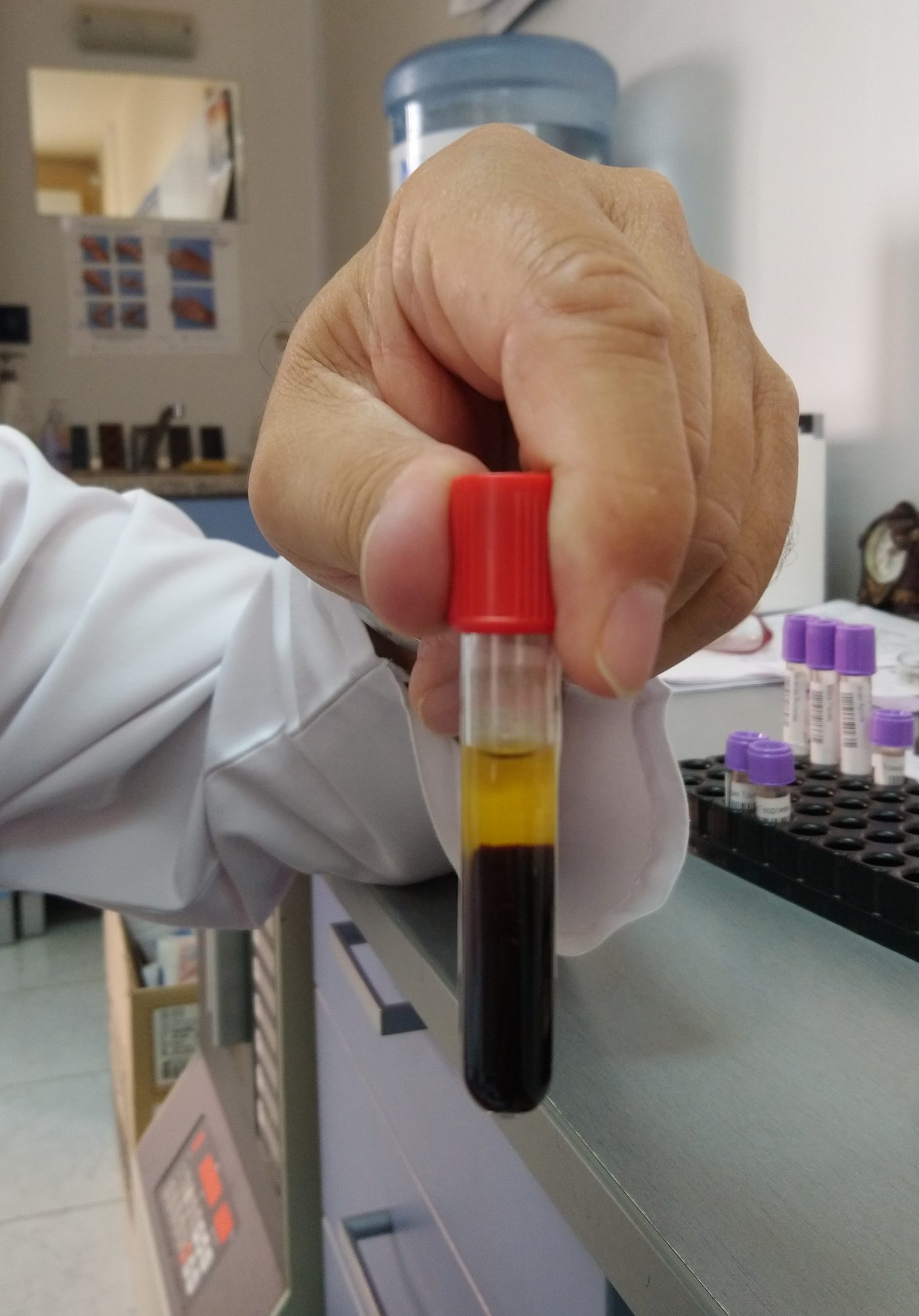
Three facts carry most processing questions: clot before you spin, separate within two hours, and RCF not RPM. When a question shows a delayed-separation specimen with a high potassium on a healthy patient, the answer is the time delay, not the patient.
Try the question your examiner is most likely to ask
An outpatient with no cardiac or renal history has a potassium of 6.6 mEq/L. The serum tube was drawn cleanly but sat on the counter for four hours before it was centrifuged and separated. What is the most likely cause of the elevated potassium?
Take the full free 10-question quiz →
Standards reference: CLSI GP44 (Procedures for the Handling and Processing of Blood Specimens for Common Laboratory Tests) for the two-hour separation limit and centrifugation guidance, cross-referenced against the ASCP BOC PBT content guideline, processing domain. PhlebotomySkills.com is exam-preparation content. Not a degree, not for-credit coursework, and not affiliated with any certifying body. Always follow your own laboratory's validated processing protocol.
Finished reading?
Next: Temperature limits
Ready to test yourself?
Practice bank · Simulator · Flashcards
Practice with explanations, then return to the topic you need.