Loading your progress…
Special collections: identify the program first.
Separate adult cultures, newborn screening, blood donation, and timed glucose by their own eligibility, specimen, timing, and documentation rules.
One label does not make four procedures interchangeable
A blood culture, a newborn dried-blood-spot card, a blood donation, and a timed glucose specimen all involve collecting blood. Their first decision is different. Before choosing a device or writing a time, identify the program and order, the person who may perform each step, the specimen and collection system, the event that starts any clock, and the record the receiving team needs. The instructions for one program cannot supply missing details for another.
Preserve each set
Record the actual volume, time, site, method, and collector for each set. Under the cited CDC adult model, the second set comes from a separate venipuncture site. A planned volume is not the volume collected.
Protect the card
In Newborn Screening Ontario's dried-blood-spot program, a printed circle is saturated in one step from one side. Layering drops onto a partly filled spot can make the applied blood uneven. Ask the program to determine whether a repeat is needed.
Confirm eligibility
For routine U.S. blood donation, the blood establishment determines eligibility before collection from its required records, appropriate last-donation interval, medical history, and physical assessment. A prior donation or a willing donor does not complete today's screen.
Name the clock
The ordered pathway defines the fasting baseline, glucose drink, and subsequent timed checks. The appointment time is not automatically the drink time. Record the event the particular order uses and clarify any missed interval.
Adult cultures: trace contamination back to the collection
CDC's adult collection model treats skin preparation and bottle-septum disinfection as separate steps. A clean venipuncture site does not clean a bottle closure. The model asks the team to collect multiple independently documented sets, usually using a separate venipuncture site for the second set, and to transport them promptly for processing. Record each bottle's observed volume, exact collection time, anatomic site, method, collector, and facility location. Those facts help the laboratory interpret a possible contaminant and distinguish a short fill from a correctly filled set.
This is adult guidance for a suspected bloodstream infection, not a pediatric bottle-volume rule. The current culture system and institution decide the disinfectant, bottle combination, target volume, and what to do when a planned second site cannot be used. Never replace an actual measurement or site with the planned one to make the record look complete.
Donation screening is a separate responsibility
FDA 21 CFR 630.10 places donor eligibility with the collecting establishment. For routine donations it is determined on the donation day and before collection. The rule includes defined exceptions for certain short-lived components and for clarifying incomplete answers after collection under an established procedure; those are not a general invitation to skip screening. The required process considers deferred-donor records, the interval since the last donation, medical history, and physical assessment. A collector who finds an unresolved answer or unavailable record should use the establishment's eligibility pathway rather than declare the person eligible from appearance, age, or enthusiasm.
At fictional Alder Center, a repeat donor says the last donation was “recent,” but the accessible record does not establish its date. Staff do not invent a safe interval or begin collection. They pause and send the uncertainty to the designated eligibility process. The case supplies no diagnosis or fixed deferral period.
Different handoffs, different missing facts
- Adult culture: a short-filled bottle needs its observed volume and set/site history; the laboratory and culture-system policy decide the disposition. Do not transfer blood between independently documented sets.
- Ontario dried-blood spot: a layered card needs its true collection history and the screening program's quality decision. Do not darken the circle from the reverse side to hide the problem.
- Donation: an unanswered eligibility question goes to the establishment's authorized review process before ordinary collection. Do not treat an unrelated diagnostic blood order as donor clearance.
- Timed glucose: a missed or uncertain drink time is a timing discrepancy. The ordering and performing teams determine whether the named test can proceed; a guessed time cannot restore a valid interval.
Decision point: what would you document?
A culture bottle collected at a second adult site is short of the local target, while a donor screening form has an unanswered question. Preserve the actual culture volume and site for the laboratory. Separately, pause donation collection for the eligibility team to resolve the form under its approved procedure. Neither gap is repaired by copying a target value or guessing an answer.
Recall: Which two pieces of information cannot be inferred from a photograph of a filled blood container? Its donor or patient eligibility, and the full collection identity, volume, timing, and handling record. The picture can show equipment; it cannot replace the controlled record.
Primary boundaries: CDC adult blood cultures applies to adults; Newborn Screening Ontario describes its own card program; FDA 21 CFR 630.10 governs U.S. donor eligibility; CDC diabetes testing describes baseline and post-drink phases. Each site must use its current program, assay, and device instructions.
Observe, then explain
Look closer.
Compare a historical platelet-donation scene, a manual culture bottle, and a puncture device. These are real, licensed images of different programs; none documents donor eligibility, an adult culture set, newborn-card quality, or a timed order.
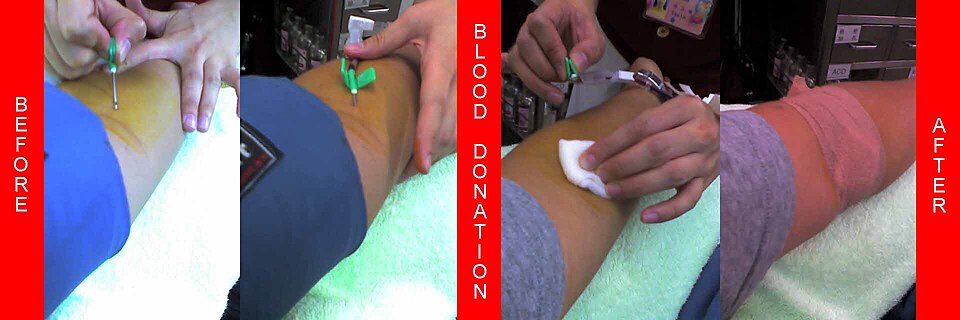
Photograph 1 of 3
A historical platelet-donation sequence
A donor-released 2006 image of their own arm during platelet donation. It shows a procedure context, not current technique, eligibility screening, device safety, or component disposition.
Photo: Toytoy at English Wikipedia. Source · Public domain, released by author.
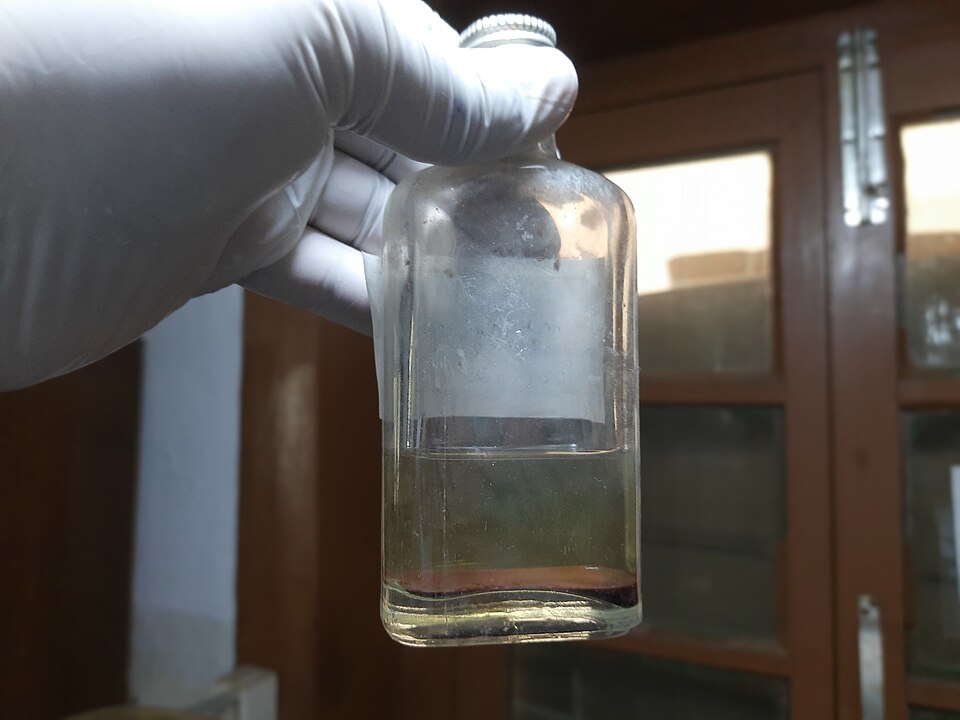
Photograph 2 of 3
A manual blood-culture bottle
A real manual-system culture bottle photographed in 2021. It is not a current collection-system instruction, and its appearance cannot establish sterility, organism growth, specimen identity, or acceptable fill.
Photo: Ajay Kumar Chaurasiya. Source · CC BY-SA 4.0.
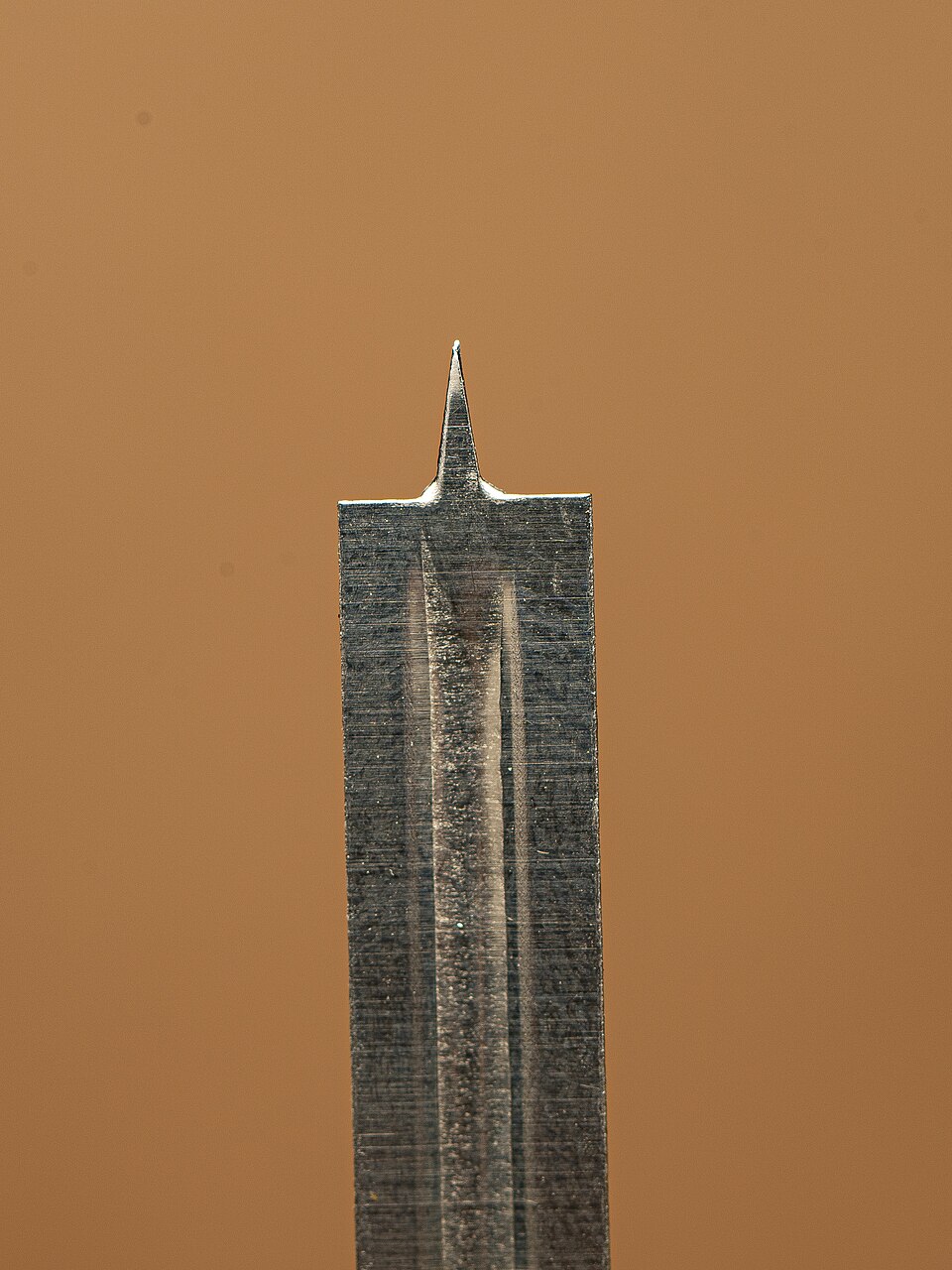
Photograph 3 of 3
Recognize an exposed sharp
An exposed metal lancet tip. This is equipment recognition, not a recommendation to use this design; select the approved single-use safety device for the patient and test.
Can any photograph establish that a donor was eligible or that an adult culture bottle and newborn card met their separate program rules?
No. A photo lacks the donor establishment record, actual culture volume and site history, and dried-blood-spot program quality decision. Use the current program instructions and controlled records; the photographed equipment is only a visual cue.
Real photographs, source and depiction checked 2026-10-14. Images display in full without cropping. A photo can support observation; use the current procedure and device instructions for clinical work.
Deliberate practice
Learn it, then use it.
These are original study prompts, not recalled certification questions. Answer before opening the rationale.
By the end, you can
- Identify the collection program before borrowing a specimen, timing, or eligibility rule.
- Preserve actual adult-culture set history and program-specific newborn card quality facts.
- Recognize that U.S. donor eligibility is an establishment decision made under the applicable FDA process.
Decision point
At a donation center, a willing repeat donor has an unanswered eligibility item. A nearby adult blood-culture bottle also filled short. Can either record be completed from what staff intended?
Reveal the best next step and why
Best next step: No. Pause ordinary donor collection for the designated eligibility process; document the culture bottle's actual volume and set/site history for the laboratory.
Why: The two programs have separate governing questions. An intended culture volume does not become a measured volume, and a past donation does not complete today's eligibility screening.
Retrieval practice
1.What four checks does the U.S. donor eligibility process consider before routine collection?
The establishment checks required donor records, an appropriate interval since prior donation, medical history, and physical assessment under its current process.
2.What starts a timed glucose interval?
The event specified in the particular ordered pathway, such as the documented drink event, rather than the appointment time by assumption.
Finished reading?
Next: Accessioning and aliquoting
Ready to test yourself?
Practice bank · Simulator · Flashcards
Practice with explanations, then return to the topic you need.